
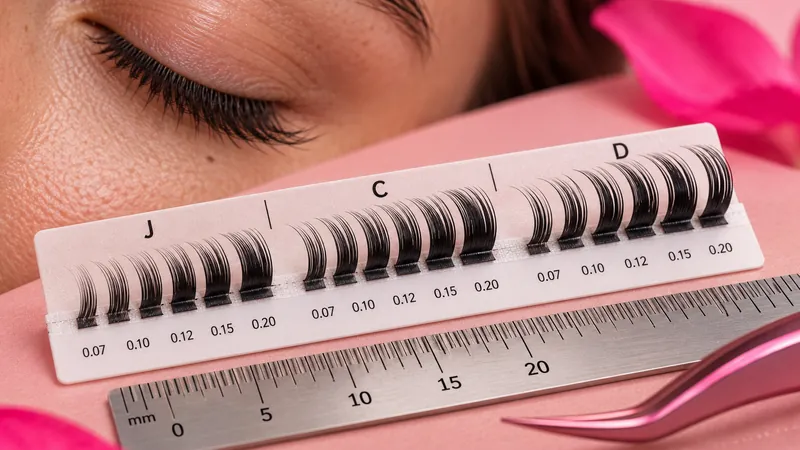
Eyelash extension materials are synthetic PBT fibres, sold as «silk» or «mink» depending on their shine and feel, in thicknesses from 0.05 to 0.20 mm and in J, B, C, D or L curls. Fibre, thickness and curl are chosen to suit your natural lashes and the technique you want.
- Almost all extensions are made of PBT, a light plastic that holds its curl in heat and humidity.
- «Silk» and «mink» are trade names: today they are synthetic fibres with no animal hair.
- Classic lashes use 0.10 to 0.15 mm; volume uses 0.05 to 0.07 mm per fibre.
- The C curl is the most requested; D and L give a more dramatic lift.
- Usual lengths run from 6 to 15 mm, shorter at the inner corner.
On this page
- What are eyelash extensions made of?
- Silk, mink and PBT: what sets them apart
- Which extension thickness suits you
- J, B, C, D and L curls: how each one changes your look
- Which lash length to choose
- Which material goes with each lash technique
- The adhesive and the other products used in your appointment
- How we work with materials at Migami
What are eyelash extensions made of?
Modern eyelash extensions are made of PBT (polybutylene terephthalate), a light and stable polyester fibre. PBT copes with shower steam and hairdryer heat without losing its shape, and it does not absorb water. That is why it is the standard in professional salons.
Each fibre is made with a tapered tip and a slightly thicker base, like a real lash. That taper gives a soft finish, so the eye never sees a blunt edge.
Silk, mink and PBT: what sets them apart
Silk, mink and PBT differ in finish, because the base material is nearly always the same polyester. The names describe how the fibre looks and feels once applied.
- Classic PBT: slightly firmer, a good deep black, holds its curl well.
- Synthetic «silk»: a mascara-like shine and a touch more flexibility.
- Synthetic «mink»: matte finish, very light and soft, the most natural-looking.
- «Cashmere» or flat fibres: lighter variants, or with a flattened base for a better grip.
Real mink, of animal origin, is hardly used because it loses its curl when wet and can cause allergies. If someone offers you «mink», ask whether it is synthetic.
Which extension thickness suits you
Extension thickness ranges from 0.05 mm to 0.20 mm and is chosen according to the strength of your natural lash. An extension thicker than your own hair weighs too much and can make it shed early.
- 0.05-0.07 mm: for volume fans, several fine fibres on one lash.
- 0.10-0.12 mm: classic lashes on fine lashes or for a subtle look.
- 0.15 mm: classic lashes with more intensity on healthy lashes.
- 0.18-0.20 mm: older thicknesses, rarely used today because they overload the lash.
At Migami we assess your lashes before we start and pick the thickness they can carry without strain.
J, B, C, D and L curls: how each one changes your look
The curl is the shape of the extension, from almost straight to strongly lifted. It changes the result a great deal, even with the same thickness and length.
| Curl | Shape | Effect |
|---|---|---|
| J | Almost straight | Very natural, lengthens without lifting |
| B | Soft | Natural, for lashes that already lift a little |
| C | Medium | Open, wide-awake look, the most requested |
| D | Strong | Like an intense lash curler, more striking |
| L | Straight base, bent tip | For straight or downward lashes, hooded or almond eyes |
Before anything is applied, we test the curl against your open eye, so you see how it sits with your eyelid and not only in a photo of someone else.
Choose your technique and let us match fibre, thickness and curl to your lashes in Andorra la Vella.
Which lash length to choose
Usual lengths run from 6 to 15 mm, and a single length is rarely used. Shorter lashes go at the inner corner and longer ones towards the centre or outer corner, depending on the design.
The practical rule is that the extension should not exceed your natural lash by more than 2-3 mm. Longer ones act as a lever, weigh more and last less. For a cat-eye effect the outer corners are lengthened; for a doll-eye look, the centre.
Which material goes with each lash technique
Each technique calls for a different mix of fibre, thickness and curl. This is the table we use as a starting point at the salon, then adjust for every client.
| Technique | Fibre | Thickness | Usual curls |
|---|---|---|---|
| Classic lashes (1D) | PBT or «silk» | 0.10-0.15 mm | J, B, C |
| 2D/3D volume | Synthetic «mink» | 0.07 mm | C, D |
| Russian volume | Ultra-light synthetic «mink» | 0.05 mm | C, D |
| Anime lashes | Mixed fibres and spikes | 0.07-0.15 mm | C, D, L |
If you are torn between two looks, our guide to which type of lashes suits you best compares the results by eye shape.
The adhesive and the other products used in your appointment
Lash extension adhesive is a cosmetic-grade cyanoacrylate that dries in a few seconds. It is the product with the biggest effect on retention and comfort. Alongside the adhesive, these products are used during the appointment:
- Primer: removes oil from the lash so the glue can grip.
- Hydrogel pads: protect the skin under the eye during application.
- Sealant or «bonder»: finishes setting the adhesive and cuts down fumes.
To see how glues are chosen and what to do if your eyes are sensitive, read our article on eyelash extension glue.
How we work with materials at Migami
At Migami, at Av. Meritxell 9 in Andorra la Vella, each extension is placed on a single natural lash, isolated from its neighbours. That way no lash carries extra weight, and they shed at their own pace That precision depends on the hands applying them; our guide on what a lash tech does explains how to compare salons.
The appointment starts with the design: eye shape, curl and lengths. Then you choose between classic eyelash extensions or the volume technique, and we pick with you the thickness your lashes can carry. Prices for each technique and for the infill at 18 days are in our price list.
What people ask us
What is the best material for eyelash extensions?
The best material for eyelash extensions is good-quality PBT, either in a matte «mink» finish or a glossy «silk» finish. PBT is light, does not absorb water and keeps its curl. The final choice depends on the thickness of your natural lashes and the look you want: more natural with classic lashes, fuller with volume.
Are mink lashes made from real animal hair?
The mink lashes used in professional salons are synthetic. The name describes their soft feel and matte finish. Real mink loses its curl in water, is harder to keep hygienic and can trigger allergies, which is why salons barely work with it.
What lash extension thickness looks most natural?
The most natural thickness for classic lashes is 0.10 to 0.12 mm, close to a real lash. Volume uses 0.05 to 0.07 mm fibres grouped into fans. A 0.15 mm thickness is more noticeable and only suits you if your natural lashes are strong.
What is the difference between a C curl and a D curl?
A C curl lifts the lash moderately and opens up the eye without looking overdone, which is why it is the most requested. A D curl is tighter and gives the effect of an intense lash curler. With hooded or drooping eyelids, a D or L curl usually looks better than a C.
Can you be allergic to eyelash extensions?
Eyelash extensions themselves rarely cause allergies, because PBT is an inert material. What can irritate is the adhesive, because of its fumes. If your eyes are sensitive, let us know before you book an appointment so we can plan your session around it.
Published on · By Denia Lemus, Migami (Andorra la Vella)